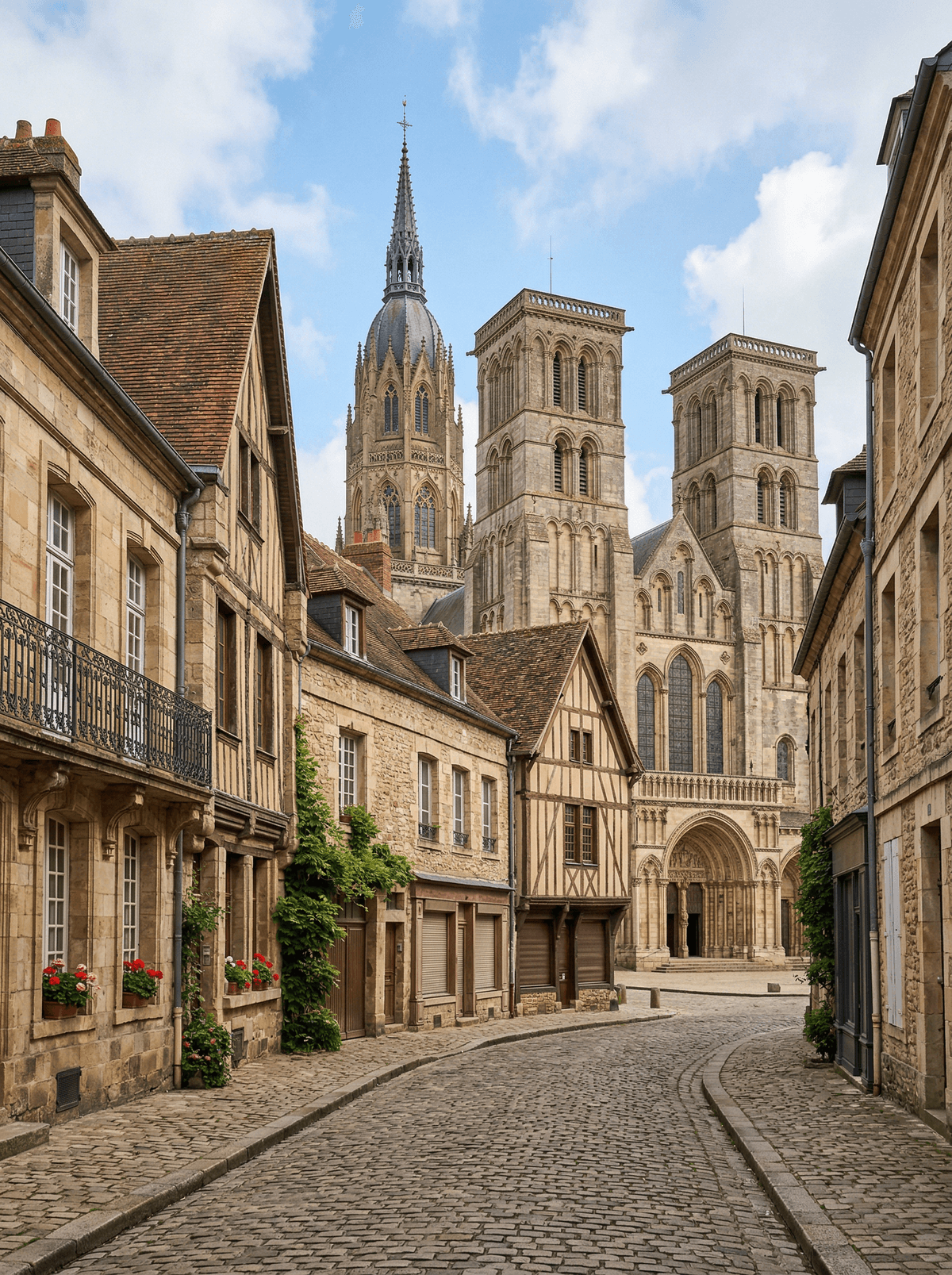
France
Bayeux
The town war forgot to bomb, keeper of the embroidery that stitched 1066.
The tapestry unrolls as a single 70-metre narrative — horses falling, arrows flying, a kingdom changing hands stitch by stitch. Bayeux, in northern France, came through the Battle of Normandy intact, its medieval streets and cathedral standing while the landing beaches lie a few minutes north, and the town is quiet in a manner that feels earned rather than accidental.
The Bayeux Tapestry is an embroidered cloth 70 metres long and half a metre high that tells William's conquest of England in 1066, and it is listed by UNESCO as a masterpiece of Romanesque art. The tapestry belongs to Bayeux, and the town's day is built on far more than one cloth: William the Conqueror's cathedral, whose spires give the town its compass point; the preserved old lanes; the Baron Gérard art museum; and the Memorial Museum of the Battle of Normandy with the Commonwealth war cemetery beside it, the largest in France. Bayeux remains the obvious base for the D-Day beaches, the Arromanches artificial harbour and the German battery at Longues-sur-Mer, all a short drive away.
Solo
Bayeux is for slow, close reading — the cathedral's stone, the museum collections, the details of streets that survived a war.
Couple
Medieval wonder in the morning, the D-Day beaches after lunch, and a quiet dinner in a town that understands the weight of what surrounds it.
Family
The cathedral, the compact old town, the clearly told story of D-Day land differently at every age, and the beaches are close enough for an afternoon.
- The Bayeux Tapestry — 70 metres of 1066 in one embroidered strip — belongs here, the town's own.
- The town came through the Battle of Normandy unscathed, its medieval centre intact while the landing beaches sit minutes away.
- William the Conqueror's cathedral gives the town its compass point — its spires are visible from almost every street.
- The Memorial Museum of the Battle of Normandy and the Commonwealth cemetery beside it tell D-Day soberly, at a level children can follow.
Tripes à la mode de Caen — offal braised for hours in cider and Calvados — the Normandy classic that divides every table.
Isigny salted-butter caramel over a warm crêpe in the old-quarter cafés.

Kimberley
South Africa
Thousands of miners erased a hill and built a diamond empire around the void.
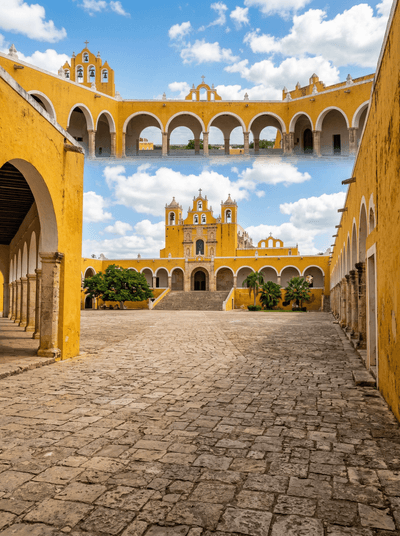
Izamal
Mexico
Yellow streets weave between Maya platforms and a vast colonial convent.
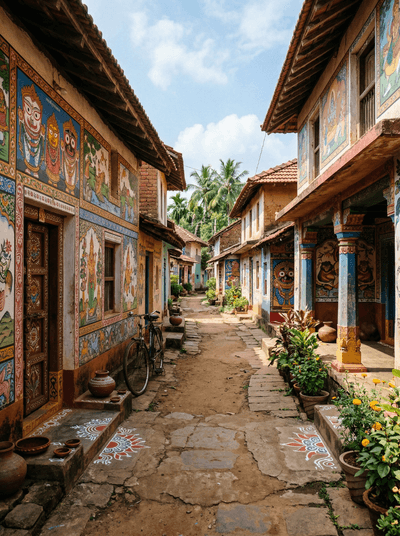
Raghurajpur
India
A village where every house wall is a canvas and nearly every family holds an artist.

Andong Hahoe Village
South Korea
One clan has lived inside this river bend for six hundred years.
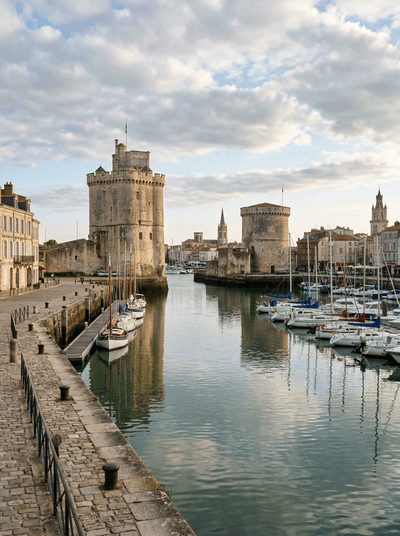
La Rochelle
France
Medieval towers guarding a harbour mouth where a chain once locked out the sea each night.
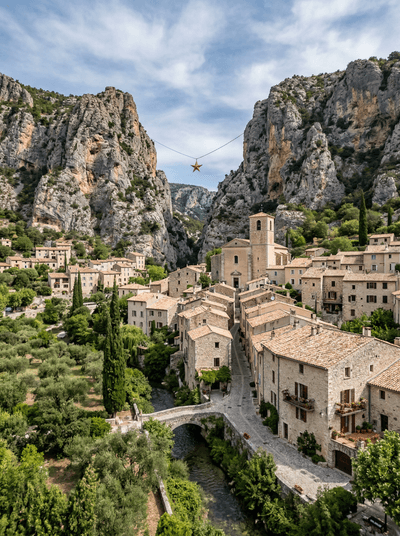
Moustiers-Sainte-Marie
France
A gold star on a chain slung between two cliffs above a village of faïence painters.
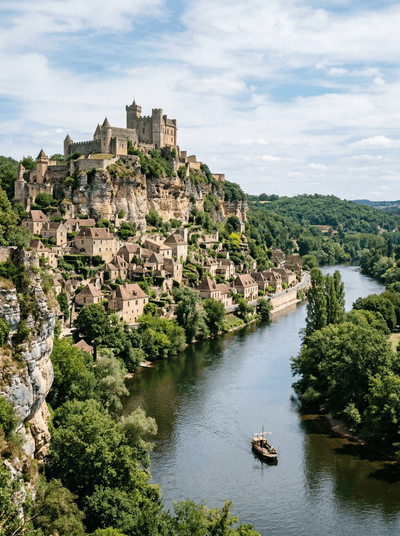
Beynac-et-Cazenac
France
A fortress village gripping a cliff high above the Dordogne's green coil.
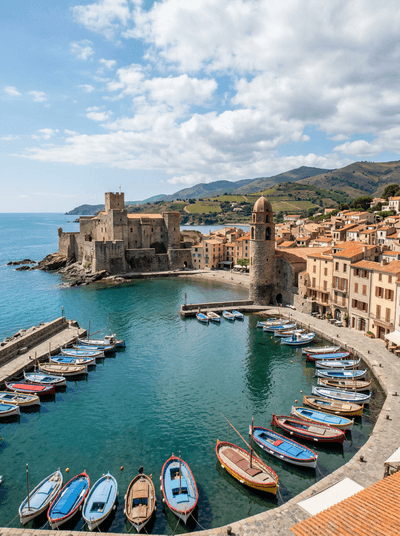
Collioure
France
Matisse's fishing port, where the light bends colour until red boats glow against violet water.